Perception 01
Context
Sees language, behavior, and contactless visual biosignals the eye misses.
reads
Core Models (OPM)
Specialized Configurations
Memory Models (OMM)
ONIOKO turns perception, biosignals, and autobiographical memory into a high-bandwidth interface for human consciousness, without a brain chip.
Not artificial intelligence. Extended intelligence and human cognition.
Perception 01
Sees language, behavior, and contactless visual biosignals the eye misses.
reads
Memory 02
Keeps what was said, confirmed, interpreted, and changed, with provenance.
keeps
Cognition 03
Connects patterns across years of decisions and expertise.
connects
Presence 04
Extended Avatars: face, voice, timing, personality, continuity.
shows up as
Perception gives context. Memory gives continuity. Cognition gives meaning. Presence makes it human.
In one picture
Perception, biological signals and memory feed the human. The human reflects. Extended cognition is the result.
This is what the technology becomes: an Extended Avatar.
The avatar is not the technology. It is its human appearance.
Signal → structure
Extended Avatars · the product
The face you just saw is the part you talk to. Everything before it is the technology behind it.
Extended Avatars are not the category. They are the first human interface to ONIOKO’s Extended Cognition technology.
Extended Avatars create a continuously personalized social and cognitive layer: attention, reflection, memory, trust, behavior.
Evidence: Plausible · see Research
Technology · how it is built
ONIOKO develops a cognitive interaction layer between humans, memory, perception, and intelligent technology.
Four layers. Two of them are ONIOKO’s own model families: OPM for perception, OMM for memory. The other two turn them into a conversation.
Open a layer: first in plain words, then the models behind it.
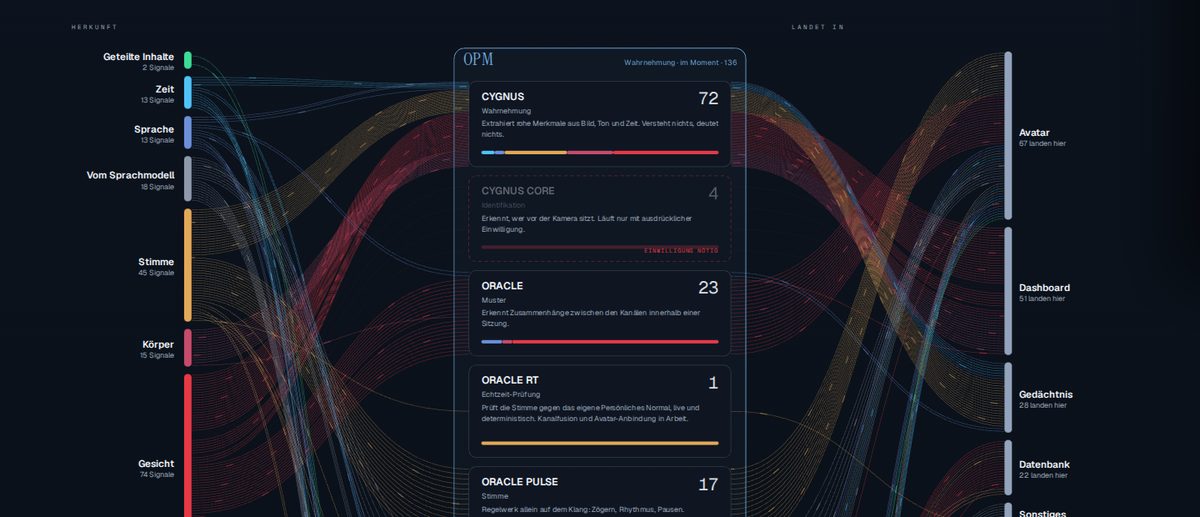
Signal map: every signal we measure →In plain words
It reads what a moment is actually made of. In the face, the voice, the body. As signal, never as a label.
It doesn’t guess what you feel. It measures how you show up: the pull of a mouth, a drop in pitch, a response that lands a beat slower than it used to. As signal, never as a label. The image and the sound are thrown away the instant they’re measured. What’s kept is the trace, never the recording.
A stroke doesn’t announce itself. Neither does the slow slide back into a depression someone climbed out of two years ago. Both leave the same early trace: a face that moves a little less on one side, a voice that loses a fraction of its melody, a beat of hesitation that wasn’t there before.
On any single day, that trace is nothing. Everyone has an off morning. A doctor would see nothing, because a doctor sees you today, next to everyone else, not next to you last month. The change only becomes visible when you have a thousand ordinary days to measure it against. That’s what perception alone misses, and it’s the whole reason perception and memory only work together.
The models behind it
OPMObservational Perception Models
Also here: Human Signal Intelligence, contactless biosignal patterns. Not a medical diagnosis.
Every signal, its source and where it lands: the signal map →In plain words
It holds who you are as it accumulates, so a person is only ever measured against themselves.
One session says almost nothing. Maybe you were tired. Maybe the mic was bad. Maybe that’s just you. Across many sessions, a corridor forms: your normal. Not the normal of people your age. Yours. And once that corridor is sharp, a real change stands out that would have been invisible on day one.
Every line in that memory keeps its source: said, confirmed, interpreted, hypothesis, changed. The instrument below shows how that reads years later.
The models behind it
OMMObservational Memory Models
The corridor above is CANON. It is built from your own sessions, and from nothing else.
In plain words
It connects what perception measured and memory kept with the situation you are in now. Years of decisions, patterns, and expertise become something you can ask.
It doesn’t decide for you. It puts the right memories, with their sources, next to the question you are asking, so you can think further than one head can hold. That is the extended in extended cognition.
The models behind it
Runs on both familiesOPM measures, OMM keeps, cognition connects
No third model family on this page. Cognition is the reasoning over what the other two produce, always with the sources attached.
In plain words
This is the part you meet. An Extended Avatar has a face, a voice, and timing: it looks at you, hears you, and answers a beat after you finish. It carries the continuity: it remembers last time.
Everything before this layer is technology. This is what it looks like when it is human.
Where you meet it
Extended Avatarsin WhatsAnima
One head across four channels: chat, voice message, video message, and video call. A text message is enough for it to stay current with you.
WhatsAnima →Signal map · every signal we measure
Every line is one signal, from its source through perception (OPM) into memory (OMM). Warm colours are measured on the body, cool ones aren’t. Nothing on the map is a mood label.
Open the map →Developer platform
SDKs, APIs, events, and data boundaries belong in documentation, not inside a model page. The developer area keeps the implementation surface separate from the technology story.
Install, initialize, version, migrate.
Authentication, resources, responses, errors.
Realtime delivery, webhooks, retries.
Consent, provenance, retention, deletion.
Intellectual core
The memory layer is what makes an avatar personal over years. This is what we mean by it.
The ability of technology to help people preserve, structure, understand, and transmit the knowledge contained in a human life.
A human biography is not merely a collection of facts. It is a living network of experiences, decisions, relationships, values, and meaning.
Where it lives: outside your head. ONIOKO keeps a structured record of your memories, with a source on every line, so you can ask it years later.
Can a long-term personalized, transparent, memory-capable artificial personality help people reflect more deeply on their knowledge, biography, and decisions, remember more reliably, and develop more effectively, without weakening autonomy, reality-testing, or human relationships?
ONIOKO hypothesis · central research program
How a memory is kept · 5 layers
A memory can carry some or all of these. Below, the labels on each memory show which layers it has.
Try it · ask one life a question
52 memories · 2008 to 20263 lives are built in, all invented. Or describe your own, and the system writes its memories on the spot. Then ask that life a question: the memories that answer it light up, in order, each with its layers.
Time runs outward from the person: the first year inside, 2026 at the rim. Tap a memory. Drag to turn.
Pick a question. The memories that answer it light up in order, each with its source.
What this life holds · highlight one ring
Research
Why we believe this works, and where we are still testing.
Four fields on the homepage. Every claim on this site carries one of 4 labels, so you can see how much evidence stands behind it. Full sources and evidence strength on Research.
I
Trust, openness, attention with virtual counterparts.
People open up to a counterpart that looks at them and remembers them. This is well studied.
II
Conversation and cues that reactivate and structure memory.
Talking about a memory, with the right cues, brings back more of it and orders it. Well studied.
III
Follow-up questions that support metacognition and decision quality.
Good follow-up questions make people think about their own thinking. Supported, not yet tested for our use.
IV
Transparent memory, uncertainty, and provenance against overtrust.
Showing where a memory came from, and how sure the system is, should keep people from trusting it too much. Our claim, under study.
Replicated studies say so.
Supported, not yet replicated for our use.
Our claim. We are studying it.
Not tested yet. We say so.
Products
Three ways to use the technology above. The first is the one you met.
A persistent, personalized presence that learns across conversations. A face and a voice you talk to, that sees you, remembers you, and keeps the record honest.
The perception instrument for people who work with people: live sessions, observable signals, and reports from OPM. The human reads them. The system never decides.
Rehearse in front of a system that reads your delivery as signal and shows you what the room will see, measured against your own last run, never against a crowd.
Use cases
Where it lands.
Companies
Education
Leadership
Family & legacy
Research & health interfaces
Bounded, consented, non-diagnostic where required.
Brands & institutions
Robotics
The same perception, the same limits: signal, never label.
All use cases
Education · Coaching · Clinical support · Sales & leadership · Public speaking · Behavioral research · Robotics →Trust & Ethics · EU AI Act
What we promise. What we refuse.
You decide what it keeps. It deletes what you say. It never guesses in secret.
Boundaries: no grief tech, no digital twin of the dead, no population scoring. EU AI Act-aware configurations available.
Rules 4 and 5 on one memory: the 2019 warehouse decision from the example above, the way ONIOKO keeps it. Every layer is visible, every layer has a source. Then rule 2: delete it.
“We decided against the second warehouse in 2019 because the lease would have locked us in for ten years.”
The year and the reason were confirmed. He added that his partner had disagreed at the time.
Long-term lock-in appears to be a recurring decision criterion for this person.
He may weigh reversibility above cost when the horizon is longer than five years.
Correction: the lease was for eight years, not ten.
0 copies retained.
The record, its interpretations, and its history are gone from this example. Nothing was kept for “training”, nothing waits in a bin. What stays is the act: one line that says a record was deleted, when, and by whom. A decision is a memory too.
Deleted · memory record · by you · content gone, act kept
Blog · Extended Humans
Where the thinking behind all of this gets written down first.
Three essays on consciousness, data, and what experience does to perception. Long form, in English, German, and Spanish.
Start with the technology, or with an Extended Avatar.
The map didn’t load in here. Open it in its own tab.